










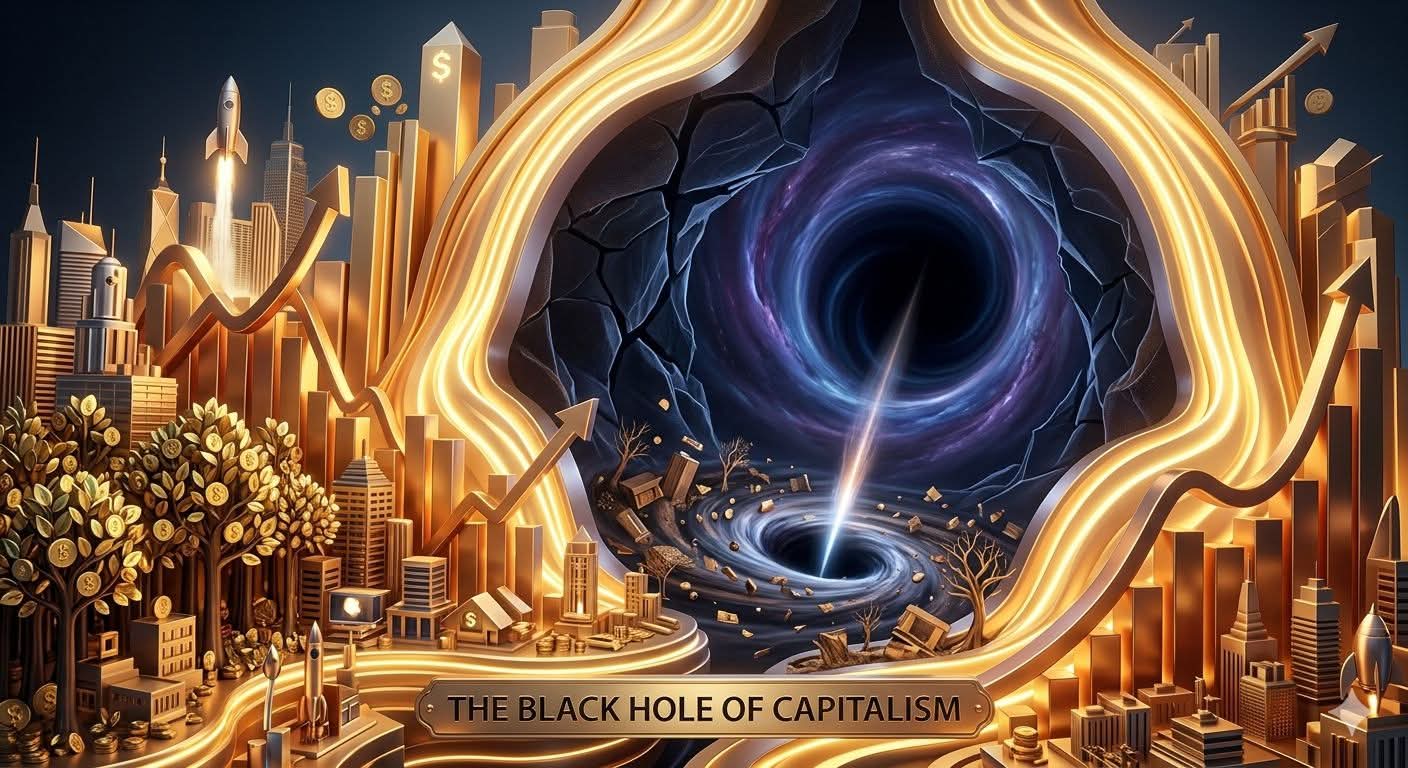
A grain of soil is almost invisible to the eye. Yet countless grains of soil collectively form the ground on which agriculture, settlements and ecosystems exist. Something similar happens in the market.
The abundance we see in a capitalist market is not created only by those who survive. It is also created by those who disappear.
But this is not simply a story of unsuccessful businesses making room for successful ones. It is something more fundamental.
Capitalism cannot keep everyone standing.
If every entrepreneur, every producer, every shopkeeper, every worker and every new venture could survive indefinitely, the very structure that capitalism depends upon would begin to change. Competition would weaken. Excess capacity would accumulate. Prices would not be forced downward in the same way. Capital would not be continuously reallocated. New entrants would find fewer opportunities to replace older ones.
Capitalism therefore does not merely tolerate failure.
It continuously produces failure.
And that failure is not an accidental by-product of the system. It is part of the system’s normal operation.
New participants enter the market. Some expand. Some stagnate. Some disappear. New firms replace old firms. New products replace existing products. New workers enter occupations while others lose their positions. New technologies make previous skills less valuable. New businesses emerge while established businesses close.
The market remains abundant precisely because this process never stops.
In that sense, the capitalist market resembles a vast field into which new seeds are continuously planted, while countless plants simultaneously disappear. We see the trees that remain. We rarely see the enormous number of seeds that failed to grow, the plants that died, or the labour and resources that disappeared beneath the surface.
The visible market is therefore only the surviving layer of a much larger economic process.
Not Only the Incompetent Disappear
One of the most important implications of this argument is that market failure cannot simply be explained by individual incompetence.
A common interpretation of capitalism is that the market rewards efficiency and punishes inefficiency. Successful entrepreneurs survive because they are better; unsuccessful ones disappear because they are weaker, less innovative or less capable.
There is some truth in this selection mechanism.
But it is not sufficient.
Many capable people fail.
A competent entrepreneur may enter a market at the wrong time. A talented publisher may produce an excellent book that fails to find sufficient readers. A highly skilled farmer may suffer from a sudden fall in prices. A technically brilliant start-up may run out of capital before its product reaches scale. A capable restaurant may close because rent, competition or changing consumer behaviour makes its business model unsustainable. A productive worker may lose employment because technology changes the structure of demand.
None of these failures necessarily indicate incompetence.
The market does not ask only:
Who is capable?
It also asks:
Who can survive under the conditions that exist at this particular moment?
These are not the same question.
A person can be capable and still disappear.
A business can be productive and still collapse.
An idea can be valuable and still fail commercially.
A worker can be highly skilled and still become economically redundant.
Therefore, the population of those who disappear into the capitalist market cannot be understood simply as a population of the incompetent.
It includes the unlucky, the undercapitalized, the poorly timed, the technologically displaced, the structurally disadvantaged—and sometimes simply those who happened to lose a competition that could not allow everyone to win.
The Market Needs a Black Hole
This is where the idea of the Black Hole of Capitalism begins.
Imagine a market in which every participant could remain permanently successful.
Every new restaurant survives.
Every publisher continues publishing.
Every farmer receives a sustainable return.
Every start-up survives.
Every shopkeeper remains profitable.
Every worker retains his or her economic position.
Every producer continues producing.
At first glance, this may sound like an ideal economy.
But it would not resemble capitalism as we know it.
Capitalism requires continuous movement.
Capital must move from one enterprise to another. Labour must move from declining sectors to expanding sectors. Consumers must move from old products to new products. Firms must enter and exit. Prices must fall for some producers and rise for others. Some investments must lose value so that other investments can become relatively more attractive.
The system therefore requires a mechanism through which economic possibilities are constantly destroyed as new possibilities emerge.
This is the black hole.
It absorbs enterprises, investments, labour, time, expectations, skills and human effort.
And because new participants are constantly entering the market, the process never reaches completion.
The black hole is continuously replenished.
Abundance Is Produced at the Edge of Disappearance
This gives us a different way of understanding market abundance.
When we enter a supermarket, we see hundreds of products.
When we open an online marketplace, we see thousands of sellers.
When we search for software, books, restaurants, educational courses or digital services, we encounter an enormous range of alternatives.
This abundance is normally interpreted as evidence of capitalist success.
But behind every visible alternative may stand countless alternatives that have already disappeared.
A successful book may stand beside hundreds of manuscripts that were never published.
A successful restaurant may stand in a neighbourhood where dozens of restaurants previously opened and closed.
A dominant technology may have emerged after countless competing technologies disappeared.
A successful entrepreneur may operate in a market shaped by the accumulated failures of previous entrepreneurs.
The abundance is therefore not simply the result of successful production.
It is also the result of continuous economic disappearance.
The market remains open for new entrants because previous participants have been removed from it.
That is not a temporary defect.
It is the rhythm of the system.
The Paradox of Productive Failure
This creates a paradox.
An individual may fail while the market benefits.
A farmer may sell tomatoes below cost. Consumers still receive tomatoes.
A publisher may fail to sell a book at its intended price. Readers may later obtain the book cheaply.
A small business may close after a failed investment. Its remaining inventory may enter the market at discounted prices.
A start-up may collapse. Its employees may carry its knowledge into other companies, while its ideas influence future products.
A freelancer may accept work for less than its full economic value. Consumers receive a cheaper service.
In each case, the individual or enterprise may experience failure while some portion of the economic value survives and enters the wider market.
This is what I call productive failure.
But productive failure should not be confused with a desirable human condition.
The fact that society benefits from someone’s failure does not mean that the person should have failed.
This distinction is crucial.
The market can convert individual loss into collective benefit without making the original loss socially visible.
The Invisible Contribution of Those Who Disappear
The market remembers the survivor.
The balance sheet records the profitable company.
The media celebrates the successful entrepreneur.
Economic statistics count production, employment and investment.
But what happens to the people who entered the market, produced something, took risks, employed others, served consumers and then disappeared?
Their contribution is rarely aggregated.
Their losses are treated as private.
Their experience becomes someone else’s knowledge.
Their unsold products become someone else’s bargain.
Their abandoned business premises become another entrepreneur’s opportunity.
Their workers become another company’s labour force.
Their failed ideas become inputs for future innovation.
Their losses therefore do not necessarily disappear from the economy.
They disappear from recognition.
This is one of the central mechanisms of the capitalist black hole.
Capitalism Cannot Let Everyone Win
The deepest point of this argument is not that capitalism is cruel because some businesses fail.
Every economic system must deal with scarcity, uncertainty and changing demand.
The deeper question is whether capitalism, as a system organized around competition, accumulation and continuous market selection, can function without continuously creating economic losers.
The answer appears to be no.
If everyone could remain economically secure regardless of competitive outcomes, the market would lose one of its principal mechanisms of selection.
If every firm could survive, inefficient allocation could persist indefinitely.
If every investment were protected from loss, capital would have less reason to move.
If every producer received a guaranteed return, competitive price pressure would change.
If every worker could retain the same economic position regardless of technological or structural change, labour would not be reallocated in the same way.
Capitalism therefore requires not merely winners.
It requires losers.
More precisely, it requires a continuous population of participants who can be displaced, replaced, absorbed, weakened or eliminated from particular markets.
This does not mean that capitalism consciously selects individuals for destruction.
It means that the system’s normal operation produces this outcome repeatedly.
And because new participants continually arrive, the process can continue indefinitely.
The Black Hole Is Not Empty
The metaphor of the black hole is therefore deliberately different from the idea of waste.
What disappears into the black hole does not necessarily become economically meaningless.
Quite often, it becomes part of the abundance that remains outside it.
Lost capital may become discounted goods.
Lost labour may become lower-cost services.
Failed experiments may become market knowledge.
Collapsed firms may release workers and technologies into other firms.
Unsuccessful products may teach consumers what they prefer.
Failed businesses may create opportunities for their successors.
The black hole is therefore not simply where value dies.
It is where value, effort and human possibility disappear from their original owners while portions of their economic consequences continue circulating through the market.
This is why the black hole is difficult to see.
The disappearance is individual.
The benefit is distributed.
The loss has an owner.
The resulting abundance often does not.
The Fundamental Asymmetry
The central asymmetry can therefore be stated simply:
The loss is often private, while the benefit can become social.
An entrepreneur bears the cost of failure.
Consumers may receive cheaper goods.
A worker bears the insecurity of employment.
Firms and consumers may benefit from lower labour costs.
A farmer bears the risk of production.
The food supply benefits from the output.
A publisher bears the financial loss.
Readers may gain inexpensive access to knowledge.
A start-up founder bears the cost of experimentation.
Later firms may benefit from the knowledge generated by that experiment.
This does not mean that every consumer or every successful company is exploiting every failed participant.
The argument is structural rather than conspiratorial.
The system does not need an intentional exploiter at every point for an asymmetry of risk and benefit to emerge.
The Real Question
The question, therefore, is not:
Why do some businesses fail?
The more important question is:
Why does a system that depends upon continuous entry, competition, innovation and abundance necessarily produce a continuous population of economic disappearance—and why are the costs of that disappearance treated primarily as private losses?
This book calls that process the Black Hole of Capitalism.
The black hole is the invisible accumulation of failed ventures, lost capital, displaced labour, abandoned opportunities, unsuccessful experiments and unrecognized contributions that continuously feed the abundance of the market.
Some of those who disappear are incompetent.
Many are not.
Some make bad decisions.
Others make reasonable decisions under conditions they cannot control.
Some lack capital.
Some arrive too early.
Some arrive too late.
Some are displaced by technology.
Some are simply defeated by competition.
And some lose despite being entirely capable of winning.
That is precisely the point.
Capitalism does not need everyone to be incompetent in order for someone to disappear. It needs competition to remain open and outcomes to remain unequal.
The market’s abundance is therefore inseparable from its capacity to eliminate participants.
New people will continue to enter.
New ventures will continue to rise.
Old ventures will continue to disappear.
The forest will remain green.
The market will remain abundant.
And beneath that abundance, the black hole will continue to grow.