





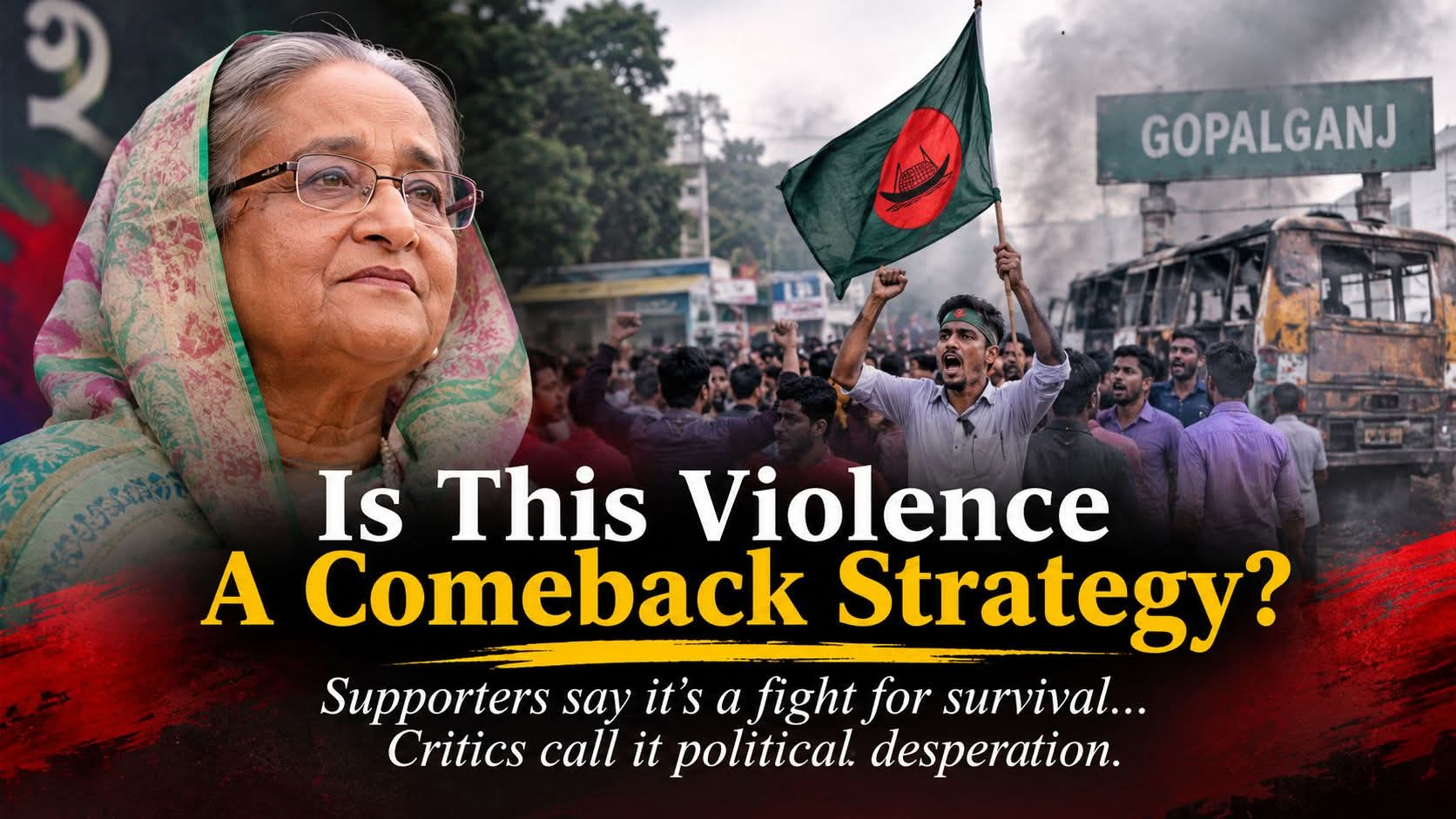
From crude bomb explosions and arson attacks to confrontational street demonstrations in Gopalganj, the former ruling party’s visible activities raise a fundamental question: Can sporadic violence restore its political relevance, or will it deepen its isolation from mainstream politics?
FollowupNews | November 16, 2026
The Awami League is facing one of the most consequential political challenges in its history following its removal from power in August 2024. More than two years after the July uprising, the party remains excluded from formal political activities, while its organisational networks and supporters continue to face an uncertain future.
In November 2026, a series of crude bomb explosions, arson attacks, road blockades and confrontational demonstrations has once again brought the party into the national political and security debate.
The developments have been particularly significant in Gopalganj, a traditional Awami League stronghold, where demonstrations escalated into clashes with law enforcement, vandalism of public property and alleged attacks on the homes of political opponents.
These incidents raise a fundamental question: Can sporadic violence bring the Awami League back into mainstream politics?
The distinction between political mobilisation and sporadic violence is essential to answering that question.
A Wave of Violence Across the Country
November has witnessed a series of security incidents involving crude bomb explosions, vehicle fires and attempts to disrupt transportation.
According to The Daily Star, at least 15 crude bomb explosions were reported in Dhaka between November 1 and November 8. Police alleged that Awami League leaders and activists were involved in attempts to destabilise the government.
On November 10, further incidents were reported in different parts of the country, including vehicle fires, cocktail explosions and road blockades. In Faridpur, a bus driver died after a parked bus was set on fire while he was sleeping inside.
On November 12, bdnews24.com reported growing concern over a series of explosions and arson incidents.
Police attributed several attacks to the banned Awami League and affiliated groups. However, allegations of political involvement must be distinguished from independently established responsibility for individual incidents.
The available reporting does not establish that every attack was centrally directed by the party’s leadership.
Gopalganj: A Local Stronghold Becomes a Centre of Confrontation
The developments in Gopalganj between November 10 and November 15 provide a particularly important case study.
Gopalganj is not simply another district in the country’s political geography. It has historical and symbolic significance for the Awami League because of its association with Sheikh Mujibur Rahman and Sheikh Hasina.
The recent demonstrations therefore carry both organisational and symbolic importance.
November 10: Police Vehicle Torched and Highways Blocked
On November 10, thousands of activists associated with the Awami League, Bangladesh Chhatra League and affiliated organisations reportedly gathered in different parts of Gopalganj.
According to The Daily Star, approximately 3,000–4,000 activists assembled near Tungipara Bus Stand around 9:30 am and blocked the road.
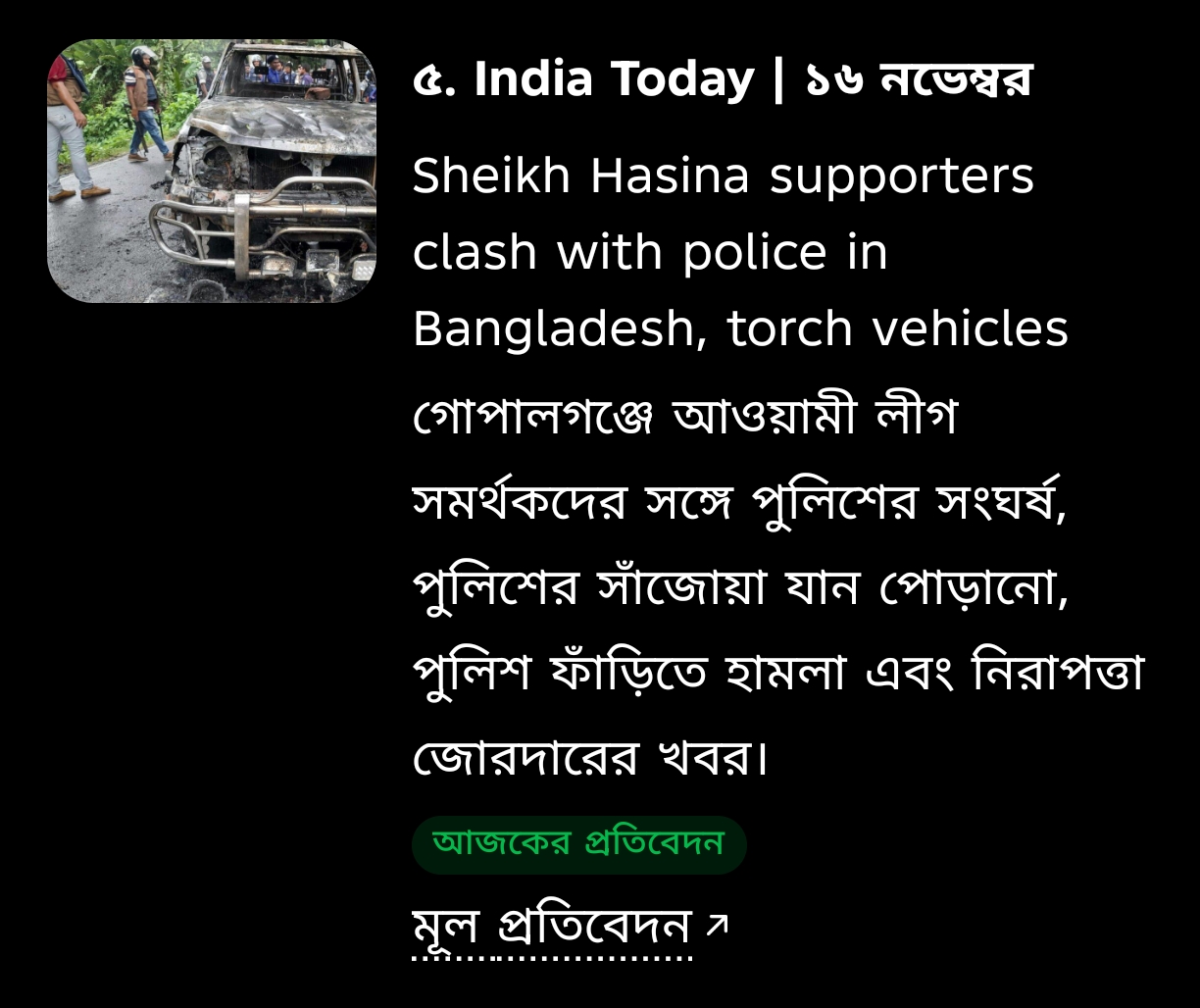
When police attempted to stop the gathering, clashes followed. A police pickup van was set on fire, and police used tear gas and rubber bullets to disperse protesters.
Road blockades were also reported on the Dhaka–Khulna highway and near BSCIC Bridge. Six platoons of Border Guard Bangladesh were deployed.
The incident demonstrated that the party’s local networks could still mobilise sizeable groups, although the scale of a district-level demonstration cannot establish nationwide political support.
November 11–13: Anti-Terrorism Act Case and Arrests
The confrontation was followed by legal action.
On November 11, police filed a case under the Anti-Terrorism Act against 153 named individuals and 300–400 unidentified people over the November 10 incidents.
According to The Daily Star, seven people were arrested and subsequently sent to jail after being produced before a court.
Police alleged that activists carried locally made weapons, including oars, shields and spears, vandalised a covered van and blocked roads by felling trees and setting tyres on fire.
These allegations remain subject to judicial proceedings.
November 15: From Demonstration to Direct Confrontation
The situation escalated further on November 15.
Hundreds of Awami League leaders and activists reportedly marched through Gopalganj town, carrying wooden poles, sticks and traditional weapons known locally as logi-boitha.
According to The Daily Star, the procession began near BSCIC Bridge after demonstrators broke through police barricades.
The procession moved through Launch Ghat, Women’s College and the Shilpakala Academy area, with participants chanting slogans in support of Sheikh Hasina.
Several incidents were reported:
- Protesters allegedly spray-painted political slogans on a police armoured personnel carrier.
- A police box near Launch Ghat was vandalised.
- The July Monument was damaged.
- The nameplate of Hadi Chattar at Gopalganj Science and Technology University was removed.
- The nameplate of Gopalganj Government College was replaced with a banner reading “Government Bangabandhu College”.
- Protesters reportedly reopened the local Awami League office in Bank Para.
- Tyres and other materials were set on fire at several road intersections, disrupting traffic.
The situation became more serious in the evening when at least seven houses belonging to BNP leaders and activists were reportedly attacked.
One of the targets was the residence of Emdad Hossain Mollah, president of Tungipara municipal BNP. BNP district leaders alleged that the house was looted and set on fire.
Police confirmed receiving information about the attacks and said they were investigating.
The government subsequently withdrew Deputy Commissioner Md Arif-Uz-Zaman and transferred Superintendent of Police Md Habibullah. They were replaced by GM Sharfaraz and Pratyush Kumar Majumdar, respectively.
According to The Daily Star, 1,350 police personnel were deployed across the district, alongside approximately 150 BGB personnel in six platoons.
The state news agency BSS also reported vandalism of public property, the July Memorial and the university’s Hadi Chattar, as well as a crude bomb explosion near the Press Club.
Political Mobilisation Is Not the Same as Sporadic Violence
The Gopalganj incidents highlight an important distinction in political science.
Political mobilisation involves organising people around shared demands, political identities and collective objectives. It can take the form of demonstrations, strikes, campaigns, public meetings and electoral activities.
Sporadic violence, by contrast, refers to isolated or scattered acts of violence occurring within a broader political environment.
Organised violence involves a different level of planning, coordination and command.
These categories should not be confused.
Breaking a police barricade, setting a vehicle on fire, vandalising a monument or attacking the residence of a political opponent does not automatically constitute a revolutionary movement.
Similarly, the occurrence of violence during a political movement does not mean that the entire movement is defined by violence.
The July 2024 uprising itself must be understood in its broader social and political context, including mass participation, demands for accountability and opposition to the government’s actions.
Reducing that uprising to isolated acts of violence would ignore its wider historical significance.
The Awami League’s Legal and Political Dilemma
The party’s difficulties extend beyond street confrontations.
The UK Home Office’s October 2026 assessment describes the political restrictions imposed on the Awami League, including the ban on its activities and the suspension of its registration by the Election Commission on May 11, 2025.
As a result, the party could not participate in the February 2026 national election.
Despite these restrictions, the party retains supporters, former officeholders and local organisational networks.
This creates a difficult political situation: retaining a supporter base is not the same as having the institutional opportunity to translate that support into electoral representation.
Nor can street demonstrations independently resolve the party’s legal and political difficulties.
Any sustainable return to mainstream politics would require a credible legal process, accountability and a legitimate political framework.
Political Violence Is Not Exclusive to One Party
The broader political environment also demonstrates that violence in Bangladesh cannot be attributed to a single organisation.
According to the Human Rights Support Society (HRSS), its October 2026 report documented at least 70 incidents of political violence, resulting in 12 deaths and 334 injuries.
| Indicator | Reported figure |
|---|---|
| Total incidents | 70 |
| Deaths | 12 |
| Injuries | 334 |
| BNP–BNP clashes | 35 |
| BNP–Awami League clashes | 7 |
| Awami League–Awami League clashes | 1 |
| BNP–Jamaat clashes | 6 |
These figures suggest that factional disputes and inter-party competition remain significant sources of political violence.
The implication is twofold.
First, law enforcement must investigate individual incidents without political selectivity.
Second, allegations against Awami League activists must not be dismissed simply because other political groups are also involved in violence.
Accountability should apply equally, regardless of political affiliation.
Sheikh Hasina’s Proposed Return and the December Question
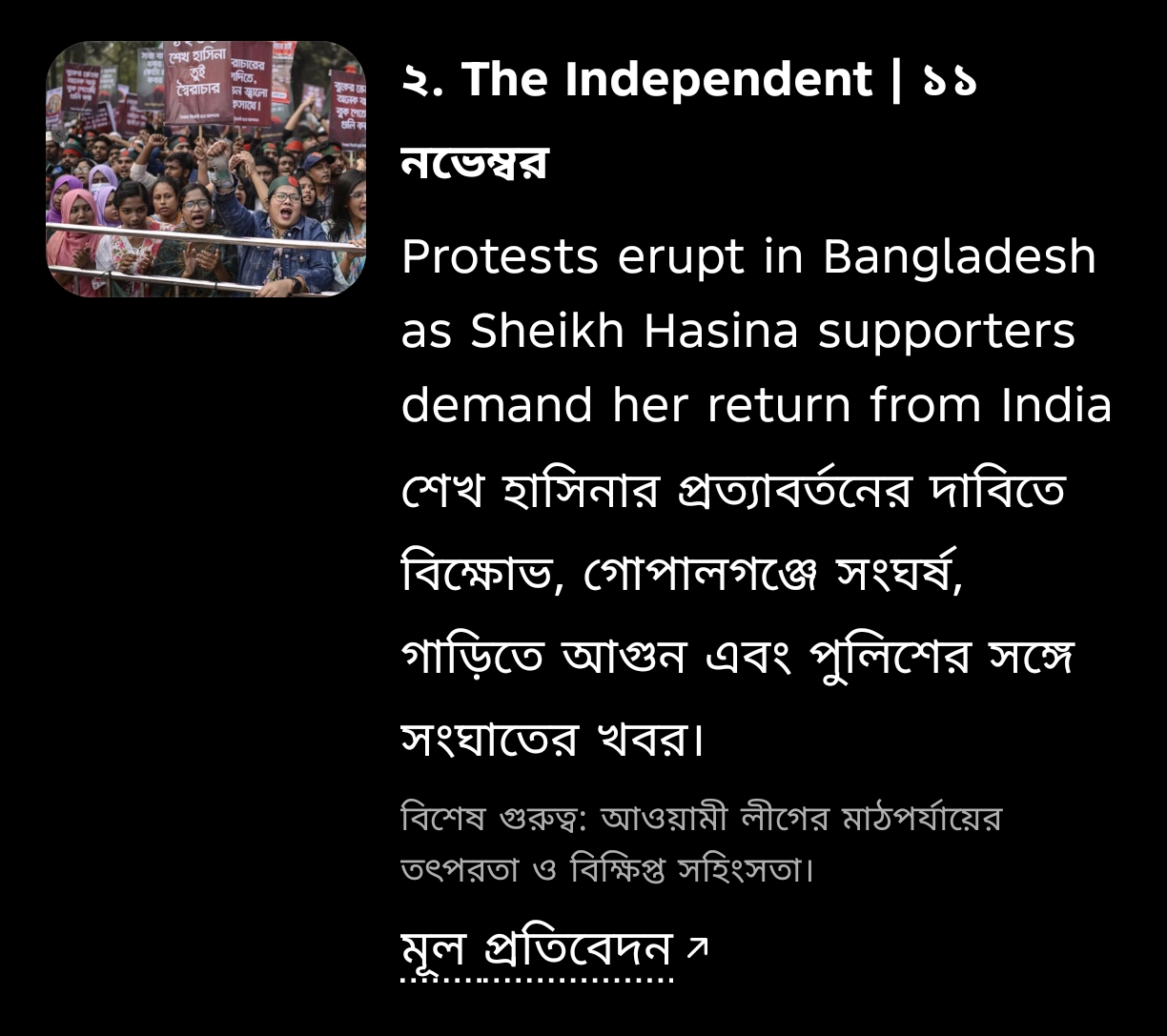
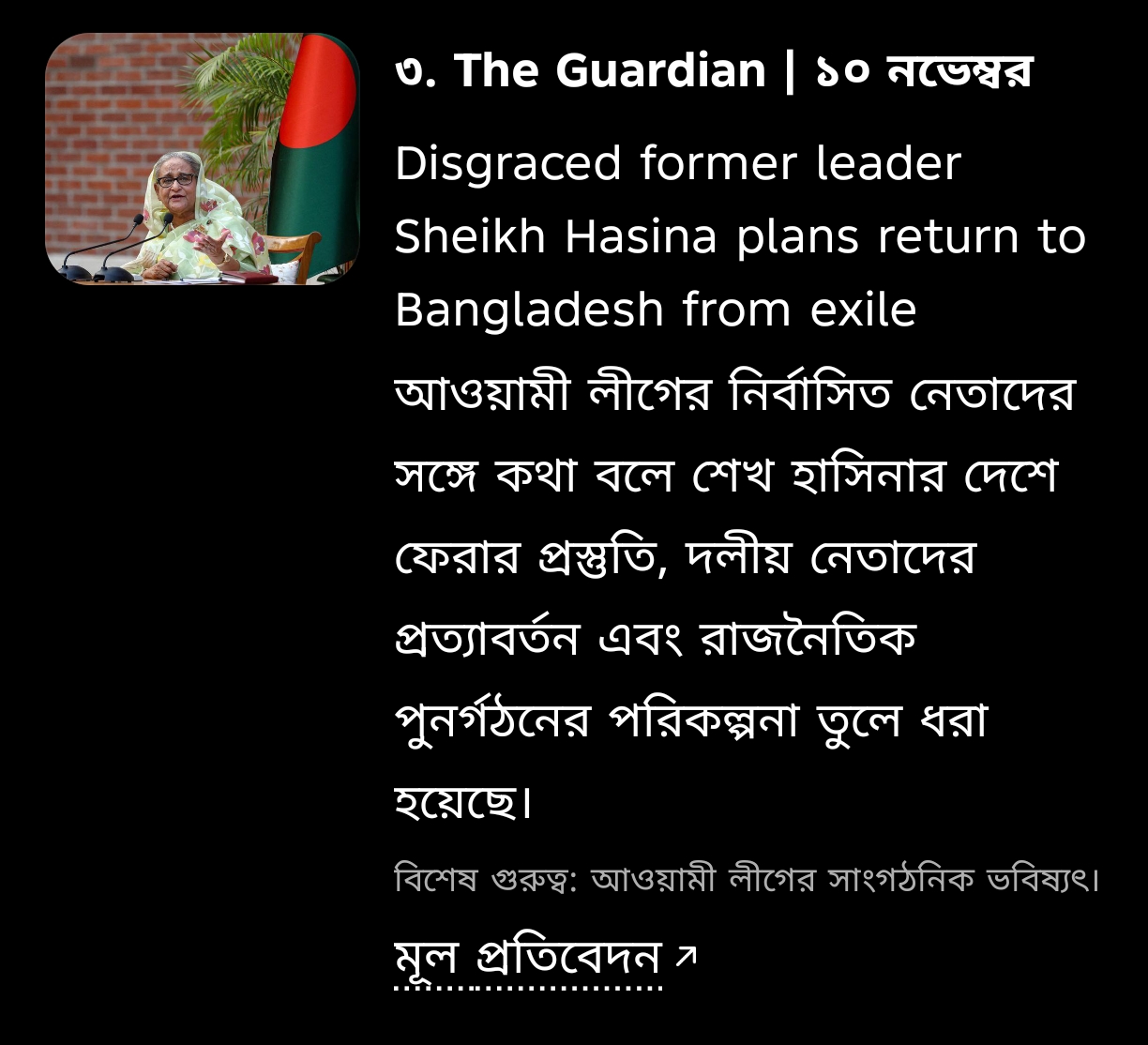
Former Prime Minister Sheikh Hasina’s proposed return to Bangladesh in December has added another dimension to the political debate.
Reuters reported on November 10 that her proposed return had become a significant political issue. She was sentenced to death in 2025 in connection with the crackdown on protesters in 2024. She denies the allegations against her.
Her proposed return could become a focal point for Awami League supporters.
However, the return of a political leader and the political rehabilitation of an entire party are two separate matters.
Even if demonstrations occur around her return, their size, geographical reach, public participation and political objectives would need to be independently assessed.
A few confrontational demonstrations cannot establish that the party has regained nationwide organisational strength.
What Do the Gopalganj Events Actually Demonstrate?
The developments in Gopalganj offer several indicators of the party’s present political position.
| Political indicator | What the incidents suggest |
|---|---|
| Local organisational capacity | The ability to mobilise sizeable groups remains |
| Street presence | Demonstrations and road blockades can still be organised |
| Political messaging | Support for Sheikh Hasina remains visible |
| Public acceptance | Cannot be established through demonstrations alone |
| Nationwide electoral support | Cannot be inferred from Gopalganj |
| Political legitimacy | Requires broader public confidence |
| Central command | Direct involvement of central leadership remains unverified |
Gopalganj demonstrates that the Awami League has not necessarily lost all local organisational capacity.
But organisational survival, street disruption and political rehabilitation are three different things.
The party’s ability to bring people onto the streets may demonstrate its remaining networks. It does not automatically demonstrate that the wider population is willing to support its return to power.
Can Sporadic Violence Restore Political Relevance?
There are several possible consequences of a strategy increasingly associated with sporadic violence.
1. Greater public alienation
When ordinary citizens experience disruption, arson and insecurity, they may become less receptive to the political message of those associated with such incidents.
2. Intensified security operations
Repeated attacks can prompt stronger law-enforcement responses, potentially narrowing the space for peaceful political activity.
3. Further political isolation
Moderate supporters, former allies and potential political partners may become reluctant to associate themselves with a party whose visible activities are increasingly linked to violence.
4. Displacement of political debate
Instead of discussing accountability, democratic rights, economic policy and the party’s political programme, public debate may become dominated by security incidents and criminal allegations.
However, the government’s response is equally important. Indiscriminate arrests, collective punishment and restrictions on peaceful political expression could deepen existing grievances.
A democratic political environment requires both accountability for violence and protection of lawful political participation.
Disruption Is Not Political Revival
The Awami League may still possess local organisational networks, committed supporters and the ability to organise demonstrations. The events in Gopalganj demonstrate that its presence in certain political strongholds remains visible.
But political visibility is not political legitimacy.
Crude bomb explosions, vehicle arson, attacks on political opponents and the disruption of public life cannot, by themselves, establish popular support or create a sustainable pathway back to mainstream politics.
The party faces a much larger challenge: rebuilding public confidence, addressing allegations of human rights abuses, confronting the political consequences of the July 2024 uprising and establishing a credible programme for the country’s future.
The government, meanwhile, must distinguish between criminal violence and peaceful political opposition.
A political party may demonstrate that it can still disrupt public life. But demonstrating that it can once again earn public trust is an entirely different challenge.
The ultimate test of the Awami League’s political future will not be how many streets it can occupy or how frequently violence occurs in its name. It will be whether it can return to politics through public confidence, accountability and legitimate democratic participation.
References and Further Reading
- UK Home Office – Country Policy and Information Note: Political Situation in Bangladesh, October 2026.
- The Daily Star – Crude bomb blasts, bus arson raise security alarm, November 8, 2026.
- The Daily Star – Police vehicle torched in Gopalganj clashes; six BGB platoons deployed, November 10, 2026.
- The Daily Star – 153 named in Gopalganj violence case under Anti-Terrorism Act, November 13, 2026.
- The Daily Star – Awami League activists breach barricades, set road fires in Gopalganj, November 15, 2026.
- The Daily Star – Chaos in Gopalganj: AL supporters go on the rampage, November 16, 2026.
- Bangladesh Sangbad Sangstha (BSS) – Report on vandalism and violence in Gopalganj, November 15, 2026.
- bdnews24.com – Report on explosions and arson incidents, November 12, 2026.
- Reuters – Report on Sheikh Hasina’s proposed return to Bangladesh, November 10, 2026.
- Human Rights Support Society (HRSS) – Human Rights Situation in Bangladesh, October 2026.
Editorial note: Police allegations, party claims and media-reported incidents are distinguished from judicially established facts. The available reports do not establish that all incidents were centrally directed by the Awami League leadership.